


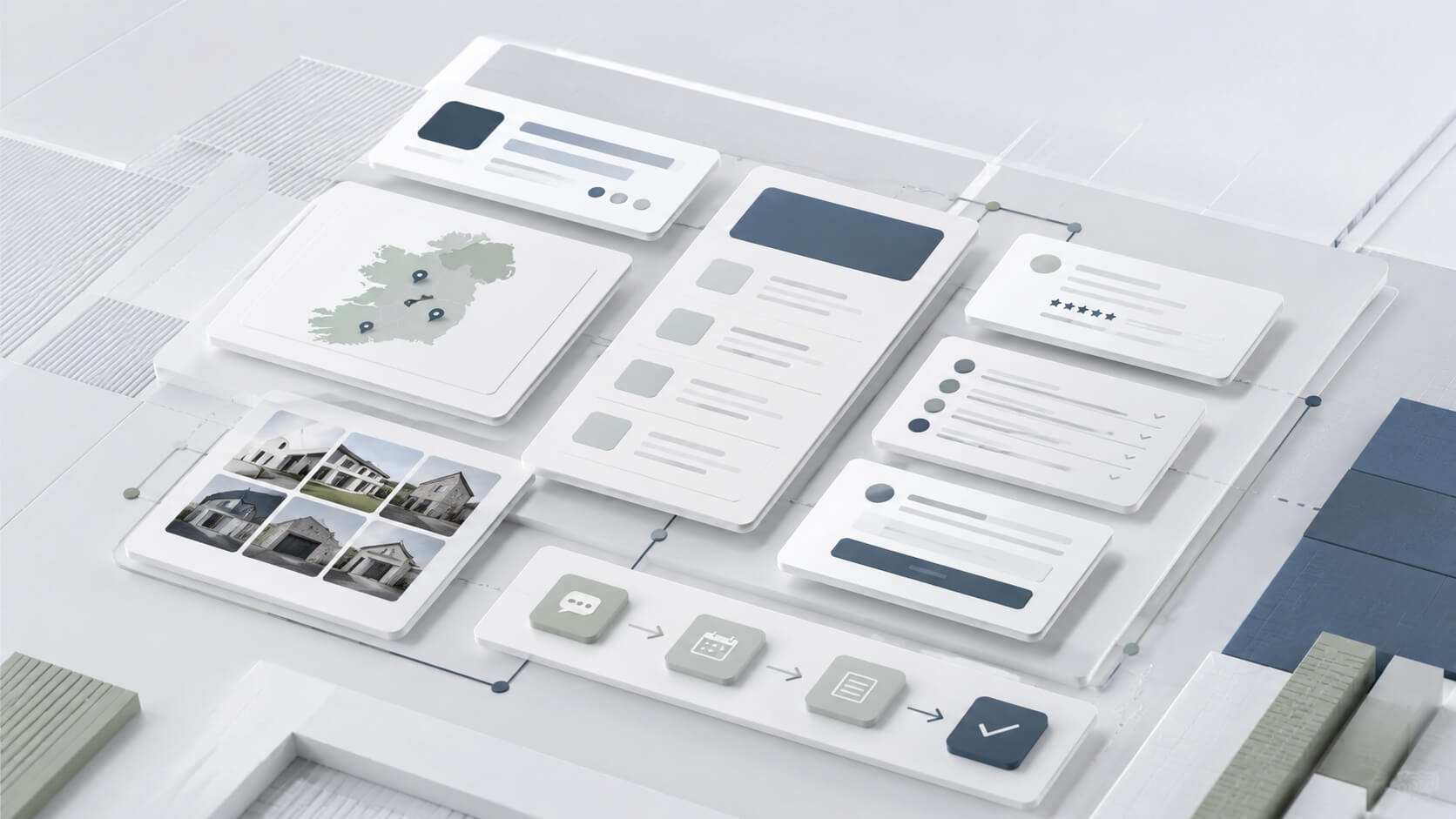
A contractor website has one primary purpose before anything else.
It should help visitors understand what you do, trust your business and contact you without confusion.
This applies to builders, roofers, landscapers, oil tank installers, electricians, plumbers, maintenance companies and other local service providers across Ireland.
Most visitors arrive with a simple question:
Can this business help with the job I need done?
Your website should answer that question immediately.
Why contractor websites often lose valuable enquiries
Many contractor websites look professional at first glance but still fail to generate enquiries.
The issue is rarely a single design flaw. More often, it comes down to poor structure.
Visitors have to search for information. Services are unclear. Service areas are hidden. Previous work is difficult to find. Contact details are buried.
A well-structured website for local service businesses in Ireland should make the next step obvious.
Your homepage should explain the business within seconds
The homepage is more than a welcome page.
For many visitors, it is the page that determines whether they stay or leave.
What should appear above the fold?
The first section of your homepage should clearly communicate:
- what service you provide
- where you operate
- why customers should trust you
- how to contact you
For example:
Weak headline:
Welcome to our website
Stronger headline:
Roofing Contractor Serving Dublin and Surrounding Areas
Or:
Oil Tank Replacement Across Leinster
Visitors should never have to guess what your business does.
Create dedicated sections or pages for key services
A contractor website should not hide all services inside a single paragraph.
If you offer multiple services, each important service should have its own section or page.
Example structure for a roofing company
A roofing contractor may need pages for:
- roof repairs
- flat roofing
- gutter replacement
- emergency roofing services
- roof maintenance
- roof inspections
Example structure for an oil tank company
An oil tank specialist may need pages for:
- oil tank replacement
- oil tank relocation
- oil tank removal
- oil tank base installation
- leaking oil tank support
Each service page gives you space to explain the work properly.
It also helps Google understand your website, which supports better visibility and contributes to having an SEO-ready website.
Avoid relying on a single services page
A generic “Services” page is often too limited.
While it may work for a very small business, it can restrict future growth.
A stronger website structure
Most contractor websites benefit from including:
- homepage
- individual service pages
- service area information
- project gallery or case studies
- FAQ section
- contact page
- blog or advice section
This does not mean your website needs dozens of pages.
It simply means your most important services should be easy to find.
Clearly show where you work
Location matters for contractors.
Many customers search using both a service and a location.
Examples include:
- roofer in Meath
- oil tank replacement Dublin
- landscaper near Navan
- bathroom renovation Kildare
Your website should clearly communicate your service area.
What location information should include
Add details such as:
- counties covered
- major towns served
- wider service regions
- emergency call-out availability
- examples of local projects
Avoid creating low-quality pages for every town.
Instead, provide genuine and useful information about where you work.
Build trust with evidence, not claims
Most contractor websites describe themselves as reliable, professional and experienced.
Customers expect more than that.
They want proof.
Trust signals that work
Consider including:
- real project photographs
- before-and-after images
- Google reviews
- years of experience
- a clear work process
- warranty information where applicable
- visible contact details
- examples of completed projects
- customer case studies
A contractor website should feel authentic and active rather than generic.
This is often why businesses eventually invest in a website upgrade.
Real photographs are more effective than stock images
For contractors, genuine project photos usually outperform polished stock photography.
They demonstrate that your business is active and experienced.
They also help potential customers visualise the quality of your work.
Useful photo categories
Include images of:
- completed projects
- work in progress
- before-and-after transformations
- materials used
- equipment on site
- company vehicles
- challenging access situations
- common site conditions
The photos do not need to be professionally staged.
They simply need to be clear, relevant and genuine.
Make contacting you easy
When visitors are ready to enquire, they should not have to search for contact details.
Your phone number, enquiry form and contact options should be visible throughout the website.
Effective contact methods
Consider including:
- click-to-call buttons
- short enquiry forms
- WhatsApp or messaging options
- visible phone numbers
- quote request sections
- a dedicated contact page
For many contractor services, requesting photos can simplify the quoting process.
For example:
“Send 2–3 photos and a short description of the work required.”
This makes enquiries easier for both the customer and the business.
Explain the process clearly
Many visitors hesitate because they are unsure what happens after they make contact.
A simple process section can remove uncertainty.
Example customer journey
- Submit an enquiry
- Send photos or project details
- Receive a quote or arrange a site visit
- Approve the work
- Project completed
This creates confidence and demonstrates professionalism.
It can also reduce unnecessary enquiries from people who are not ready to proceed.
Add FAQs based on real customer questions
FAQ stands for Frequently Asked Questions.
A good FAQ section answers common concerns before customers need to ask.
Useful contractor FAQs
Examples include:
- Do you cover my area?
- How much does the service typically cost?
- Do I need to send photos?
- How quickly can you attend?
- Do you work with homeowners and businesses?
- Is your work guaranteed?
- How long does the project take?
- What information do you need for a quote?
These questions improve the user experience and can also support search visibility.
Ensure the mobile version works properly
Many visitors will view your website on a smartphone.
If the mobile experience is poor, enquiries will suffer.
Mobile website checklist
Make sure:
- text is easy to read
- buttons are easy to tap
- phone numbers are visible
- images load correctly
- pages load quickly
- navigation is simple
- contact options are easy to find
A contractor website should be designed for real-world mobile users, not just desktop visitors.
Blog articles should support service pages
Blog content can be valuable, but it should not replace service pages.
Service pages are usually responsible for generating enquiries.
Articles should support those pages.
Useful article ideas
Examples include:
- when to replace an old oil tank
- signs of roof damage
- factors that affect driveway costs
- preparing for a bathroom renovation
- what to look for when hiring a contractor
Each article should link back to the relevant service page.
This helps strengthen the website and supports long-term growth through website growth support.
What every strong contractor website should include
A well-structured contractor website should contain:
- a clear homepage
- dedicated service pages
- service area information
- real project photography
- trust-building elements
- a simple customer process
- FAQs
- clear contact options
- mobile-friendly design
- supporting blog content
The goal is not to create an overly complicated website.
The goal is to make the business easier to understand and easier to contact.
A simple website test
Look at your website from the perspective of a potential customer.
Can they quickly answer the following questions?
Questions every visitor should be able to answer
- What does this business do?
- Do they work in my area?
- Have they completed similar projects before?
- Can I trust them?
- How do I contact them?
- What happens after I enquire?
If those answers are not immediately clear, your website structure may need improvement.
Need a clearer website for your contracting business?
Site Launch builds websites for Irish contractors, tradespeople and local service businesses.
The focus is practical: clearer services, stronger structure, improved trust and easier enquiry paths.
See how Site Launch plans and builds websites for contractors and trades in Ireland.
Useful next pages: