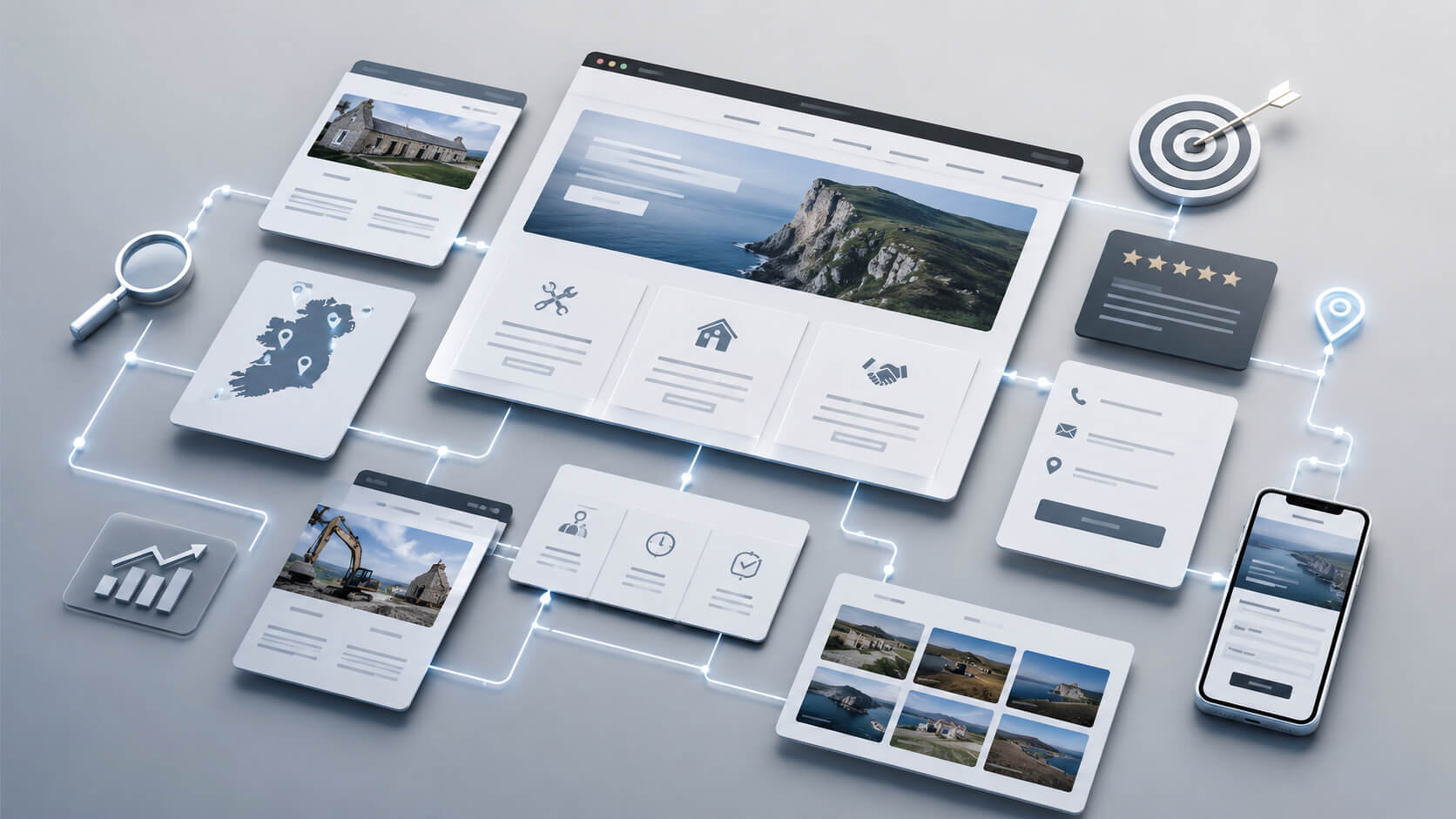
A website can look good and still be weak for Google.
That is the problem many small businesses face.
The site is live. The design looks fine. The owner expects Google to start sending people.
But the pages are too thin, the services are unclear, the headings do not help, and the website has no real structure.
That is not an SEO-ready website.
An SEO-ready website is built so people can understand it and Google can read it properly.
What does SEO-ready mean?
SEO means search engine optimisation.
In plain English, it means helping your website show up when people search for your services.
SEO-ready means the website is prepared for that from the start.
It does not mean instant rankings.
It means the website has a proper base.
An SEO-ready website should make clear:
- what your business does
- what services you offer
- where you work
- who the service is for
- how people can contact you
- which pages are most important
This helps visitors.
It also helps Google understand the site.
Why “we will do SEO later” is often a mistake
Many businesses build the website first and think about SEO later.
That usually causes problems.
If the site is built without structure, later SEO work becomes harder.
You may need to rewrite pages, rebuild sections, change URLs, add missing service pages and fix the mobile version.
That is avoidable.
A stronger approach is simple:
build the website with SEO basics from the start.
This is why Site Launch focuses on clear structure, service pages and growth support from the beginning.
Useful page: Website Growth Support Ireland
A good homepage is not enough
A homepage is important, but it cannot do everything.
Many small business websites rely too much on one page.
That limits the site.
If your business offers several services, Google needs clearer pages or sections for those services.
Example
A local service business may need pages for:
- main service
- secondary services
- service area
- FAQs
- recent work
- contact
This gives each part of the business enough space.
It also gives visitors a clearer path.
Service pages do most of the work
Service pages are the pages that explain what you actually do.
For many small businesses, these are the most important pages.
A good service page should explain:
- what the service is
- who needs it
- what problem it solves
- what is included
- where the service is available
- what the next step is
This does not need to be complicated.
It needs to be clear.
For local service businesses, this structure is especially important.
Useful page: Websites for Local Service Businesses in Ireland
Google needs clear words, not clever wording
Some websites use vague text because it sounds polished.
That can be a problem.
Google and customers both need clear wording.
Weak wording
We deliver modern solutions for your needs.
Stronger wording
Website design and rebuilds for small Irish service businesses.
Clear wording helps people understand the business faster.
It also gives Google better information.
Do not hide the service behind generic phrases.
Headings help people scan the page
Most visitors do not read every word.
They scan.
Good headings help them understand the page quickly.
Headings also help organise the page for Google.
A useful page structure may include:
- main heading
- short introduction
- service explanation
- who it is for
- common problems
- process
- FAQs
- contact section
This makes the page easier to read.
It also makes the website easier to grow.
Internal links keep the website connected
Internal links are links between pages on your own website.
They help visitors move to the next useful page.
They also help Google understand which pages are connected.
Example
A page about website rebuilds can link to:
- Website Upgrade
- Website Growth Support
- FAQ
- Local service business websites
Useful page: Website Upgrade Ireland
Internal links should be natural.
They should help the reader, not just fill space.
Mobile layout is part of SEO
A website is not SEO-ready if it works poorly on a phone.
Many customers will visit from mobile first.
If the mobile version is awkward, people leave.
Check the basics:
- text is readable
- buttons are easy to tap
- phone number or contact button is visible
- pages load quickly
- images are not too heavy
- forms are simple
- sections are not too long
Google may bring visitors.
The mobile page still has to keep them.
SEO-ready also means ready to grow
A proper website should not be frozen after launch.
Your business may later need:
- new service pages
- articles
- FAQs
- case studies
- location content
- Google Business Profile posts
- landing pages for ads
If the website is built well, adding these later is easier.
If the website is messy, every future improvement becomes slower.
That is why SEO-ready is not just about launch.
It is about building a base that can grow.
What an SEO-ready website should include
A practical SEO-ready website should include:
- clear homepage
- clear service pages
- simple menu
- readable headings
- useful page titles
- short page descriptions
- internal links
- mobile-friendly layout
- clear contact paths
- FAQs where useful
- room for future content
Nothing here is fancy.
It is basic structure done properly.
What SEO-ready does not mean
SEO-ready does not mean:
- guaranteed first-page rankings
- instant traffic
- keyword stuffing
- copied content
- fake location pages
- random blog posts
- hidden tricks
- writing only for Google
That approach usually creates weak pages.
A good website should be useful for people first.
Google then has something clear to understand.
The simple test for your website
Look at your website as a new visitor.
Can they quickly answer these questions?
Visitor questions
- What does this business do?
- What services are available?
- Where does the business work?
- Can I trust this business?
- How do I make contact?
- Is there enough detail to make a decision?
- Can the site grow with more useful pages later?
If the answers are unclear, the website is not SEO-ready enough.
SEO-ready is the starting point, not the full journey
A strong website gives your business a better base.
It helps visitors understand your services.
It helps Google understand your pages.
It makes future SEO work easier.
But it is still a starting point.
Search growth usually needs ongoing work: useful content, better service pages, Google Business Profile activity and regular improvements.
Useful page: Website Growth Support Ireland
Need an SEO-ready website for your business?
Site Launch builds websites for small Irish businesses that need clear structure, strong service pages and a better base for enquiries and growth.
Useful pages: