


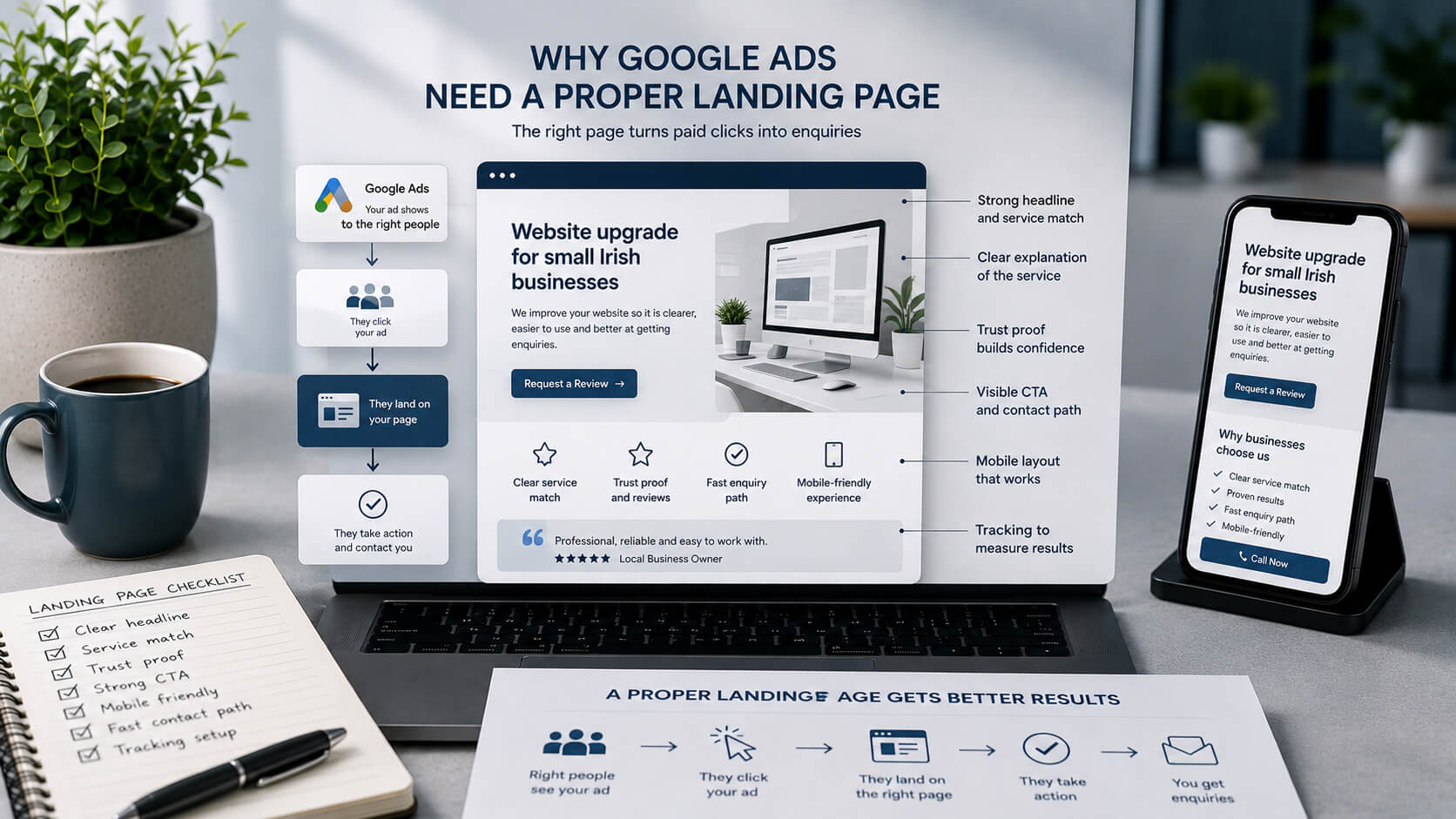
Google Ads can bring people to your website quickly.
But the page they land on matters.
If paid traffic goes to a weak or general page, the visitor may not find what they expected. That can waste the click.
A proper landing page gives the visitor a focused answer.
It matches the ad, explains the service, builds trust and makes the next step easy.
That is what a Google Ads-ready website needs.
What is a landing page?
A landing page is the page someone visits after clicking an ad, post or campaign link.
For Google Ads, the landing page should usually focus on one service or one clear offer.
It should not make the visitor search around the whole website.
A landing page should answer:
- What service is this?
- Is it relevant to me?
- Does this business work in my area?
- Can I trust this business?
- What should I do next?
- How do I contact them?
The faster the page answers these questions, the better.
Why a homepage is often too general
A homepage has a different job.
It introduces the whole business.
That means it may include several services, case studies, general trust points, blog links and navigation options.
That is useful for normal visitors.
But paid traffic is different.
When someone clicks an ad, they usually expect a specific answer.
Example
If the ad says:
Website upgrade for small Irish businesses
The landing page should be about website upgrades.
Not a general homepage where the visitor has to find the upgrade section.
Useful page: Website Upgrade Ireland
Service match is the main point
Service match means the ad and the page are clearly connected.
If the ad talks about one service, the page should talk about that same service.
Good service match includes:
- same service wording
- clear headline
- short explanation
- relevant proof
- matching CTA
- contact option for that service
This reduces confusion.
It also makes the page feel more relevant.
Paid traffic should not land on a page that feels only partly related.
The first screen has to be clear
The first screen is what the visitor sees before scrolling.
For paid traffic, this part must work quickly.
A strong first screen should include:
- clear service headline
- short explanation
- who the service is for
- trust signal
- visible call-to-action
- mobile-friendly layout
Weak first screen:
Welcome to our website.
Better first screen:
Google Ads-ready landing pages for small Irish service businesses.
The visitor should immediately know they are in the right place.
A landing page needs one main action
A general website can offer several routes.
A landing page should be more focused.
That does not mean hiding all navigation, but the page should have one main action.
Common landing page actions:
- call now
- request a quote
- send enquiry
- book a review
- send website link
- ask for a callback
The CTA should match the service.
If the business needs photos before quoting, say that.
If the business needs a short review request, make that clear.
Trust proof must appear early
Paid traffic often brings people who do not know your business.
They need proof.
A landing page should not wait until the very bottom to build trust.
Useful trust proof includes:
- reviews
- case studies
- recent work
- real photos
- service area
- clear process
- business details
- FAQ answers
- guarantees where relevant
For local service businesses, proof is not decoration.
It is part of the decision.
Useful page: Websites for Local Service Businesses in Ireland
Mobile layout matters more than desktop polish
Many Google Ads clicks come from phones.
If the mobile landing page is awkward, paid traffic will suffer.
A mobile landing page should have:
- readable text
- short sections
- visible CTA
- easy contact button
- fast loading
- simple form
- clear page order
- no clutter
Do not judge a landing page only on desktop.
The phone version can decide whether the campaign works or fails.
The page should remove doubt
A good landing page handles common doubts before they stop the enquiry.
Doubts may include:
- Is this service right for me?
- How does the process work?
- What do I need to send?
- Is this business local?
- Can I see examples?
- How quickly will they reply?
- Is there a clear next step?
This is where FAQ blocks are useful.
FAQ answers should be short, direct and placed where they help the decision.
Useful page: Website Build FAQ Ireland
A landing page should not be overloaded
Focused does not mean thin.
But it also should not be bloated.
A landing page should include enough information to help the visitor act.
Avoid:
- long generic introductions
- too many unrelated services
- vague claims
- stock phrases
- hidden contact details
- too many competing buttons
- content that does not support the offer
The page should guide the visitor from interest to enquiry.
Not distract them.
Tracking basics are needed
Tracking helps show what happens after the click.
It does not fix the page, but it helps measure performance.
Basic tracking can include:
- form submissions
- call button clicks
- WhatsApp clicks
- quote requests
- key CTA clicks
- landing page visits
Without tracking, it is harder to know whether the campaign is working.
If clicks come in but enquiries do not, the page may need work.
A proper landing page supports marketing
A landing page is not just a design asset.
It is part of the marketing system.
It connects:
- the search query
- the ad
- the service page
- the proof
- the contact path
- the enquiry
If one part is weak, the campaign can struggle.
This is why a website should be built with marketing in mind, not just appearance.
Useful page: Website Growth Support Ireland
When a homepage can work
Sometimes a homepage is enough.
That may be true when:
- the business has one main service
- the homepage is focused
- the CTA is clear
- trust proof is visible
- the mobile layout is strong
- the ad matches the homepage message
But if the homepage covers too much, a focused landing page is usually better.
The simple landing page checklist
Before sending Google Ads traffic to a page, check:
- does the headline match the ad?
- is the service clear?
- is the CTA visible?
- does the mobile version work?
- is trust proof shown early?
- is the contact path fast?
- are common doubts answered?
- is tracking ready?
- does the page have one main job?
If not, fix the page before spending on clicks.
Build the page before buying the traffic
Google Ads can bring visitors.
A landing page has to turn those visitors into enquiries.
The better order is simple:
- Define the service
- Build the landing page
- Match the page to the ad
- Add trust proof
- Make contact easy
- Check mobile layout
- Set up tracking basics
- Then send paid traffic
That is the safer way to use ad budget.
Need a proper landing page for Google Ads?
Site Launch builds and upgrades websites for small Irish businesses that need clear landing pages, stronger enquiry paths and a better base for marketing.