


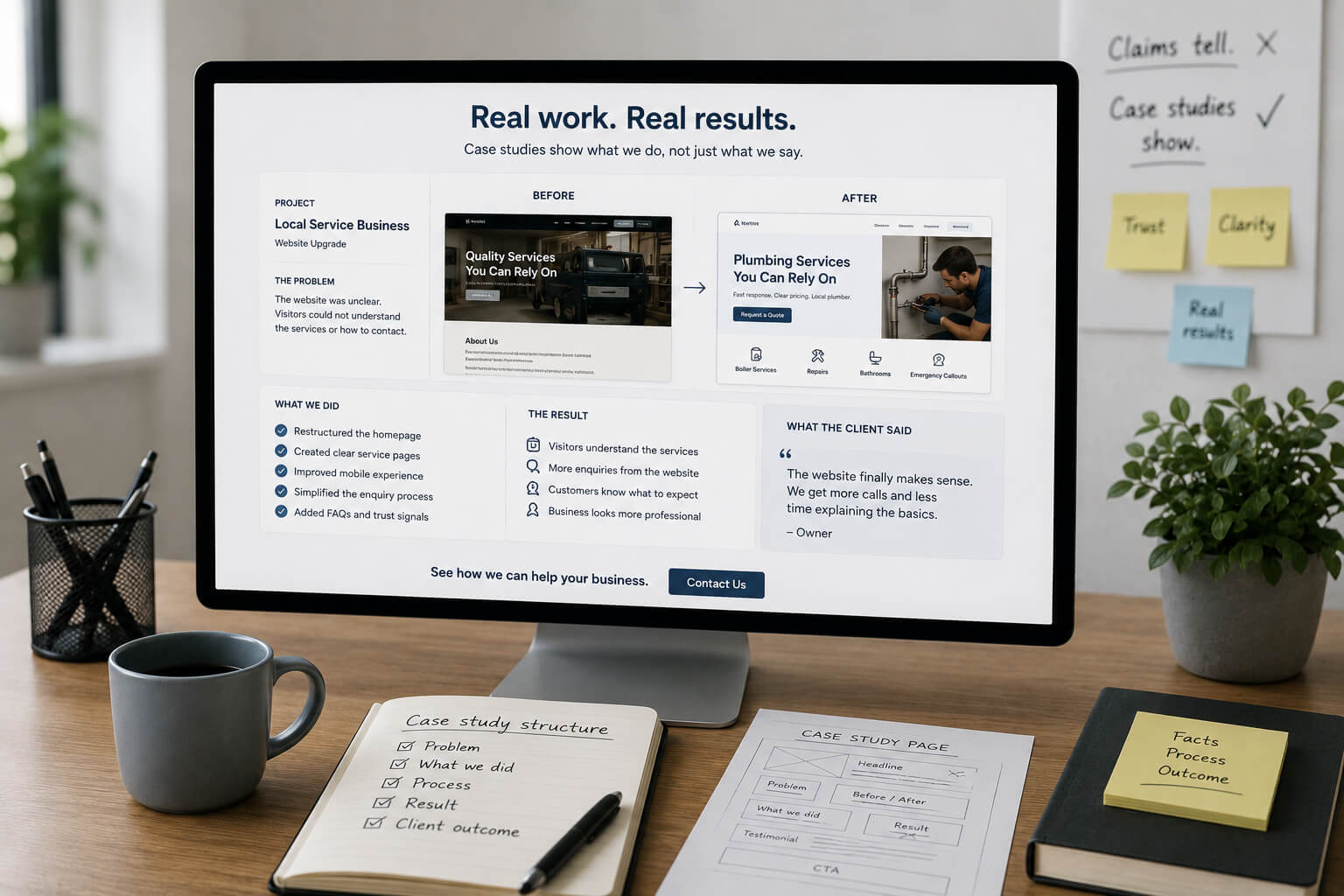
Most business websites say the same things.
Professional. Trusted. Reliable. High quality.
The problem is not that these claims are false.
The problem is that they are cheap to write.
Anyone can say them.
A case study is harder to fake.
It shows what happened.
That is why it works.
A case study is not decoration
A case study should not be a trophy.
It should answer a quiet question in the visitor’s head:
What are these people like when the job is real?
That is the useful thought.
People are not only judging the final result.
They are judging your judgement.
How you saw the problem.
What you decided to do.
How you handled limits.
What changed after the work.
Claims ask for belief
A claim says:
Trust us.
A case study says:
Here is what we did.
That is a different level of proof.
Weak claim
We build professional websites that help businesses grow.
Better proof
The old homepage was unclear, so we separated services, rebuilt the enquiry path and moved detailed content into supporting pages.
The second version gives the reader something to inspect.
Show the problem first
Do not start a case study with how great the result was.
Start with the problem.
Good case study structure
- what was unclear
- what was holding the site back
- what had to be changed
- what was built
- what became easier for the visitor
Problem first makes the work feel real.
It also helps the reader recognise their own situation.
Photos matter because they slow down doubt
Photos are not only visual proof.
They stop the reader from feeling that the page is invented.
For service businesses, real photos carry weight.
They show that work happened.
They give scale.
They make the business feel active.
A case study without any real visual proof is weaker.
Process beats praise
The best case studies do not need loud language.
They need process.
Instead of saying:
We delivered a successful redesign.
Say:
The homepage was simplified. Service details were moved to separate pages. Booking information was made easier to find. FAQs were added to reduce repeated questions.
This is less dramatic.
It is more believable.
A case study should reduce risk
A visitor is not only asking whether you can do the work.
They are asking whether choosing you is risky.
A good case study reduces that risk.
It shows:
- you understand the problem
- you do not guess blindly
- you can structure information
- you can make decisions
- you can explain what changed
- you can finish the work
This gives the signal: you can be dealt with.
Keep case studies short
A case study does not need to be a long report.
For many small business websites, a compact version is enough.
Simple format
Problem: what was unclear or missing.
Work: what was changed.
Result: what became easier.
Related service: where the reader can go next.
This is enough.
Useful page: Website Upgrade Ireland
Connect case studies to service pages
A case study should not sit alone.
It should support a service page.
If the case study is about a rebuild, link it to website upgrade.
If it shows ongoing content work, link it to growth support.
If it shows a new site structure, link it to new website build.
Useful pages:
This makes the case study part of the website structure.
Not just a portfolio item.
The hidden value of a case study
A case study does not only prove past work.
It teaches the visitor how to judge their own problem.
They may arrive thinking:
I need a nicer website.
After reading the case study, they may realise:
My website is not only ugly. The service structure is unclear. The enquiry path is weak. The proof is missing.
That is useful.
The reader leaves with a sharper understanding.
That is stronger than persuasion.
Case study checklist
A useful case study should answer:
- what was the problem?
- what was unclear?
- what changed?
- why did it change?
- what became easier for the visitor?
- what proof can be shown?
- what service does this connect to?
- what should the reader do next?
If it only says “project completed successfully”, it is too thin.
Real work beats big words
Broad claims make a website sound like everyone else.
Case studies make the business specific.
They show the work, the thinking and the result.
For a small business website, that is the point.
Do not tell people you are professional.
Show them how you work.
Need stronger proof on your website?
Site Launch builds and improves small business websites with clearer service pages, useful case studies and simple enquiry paths.