


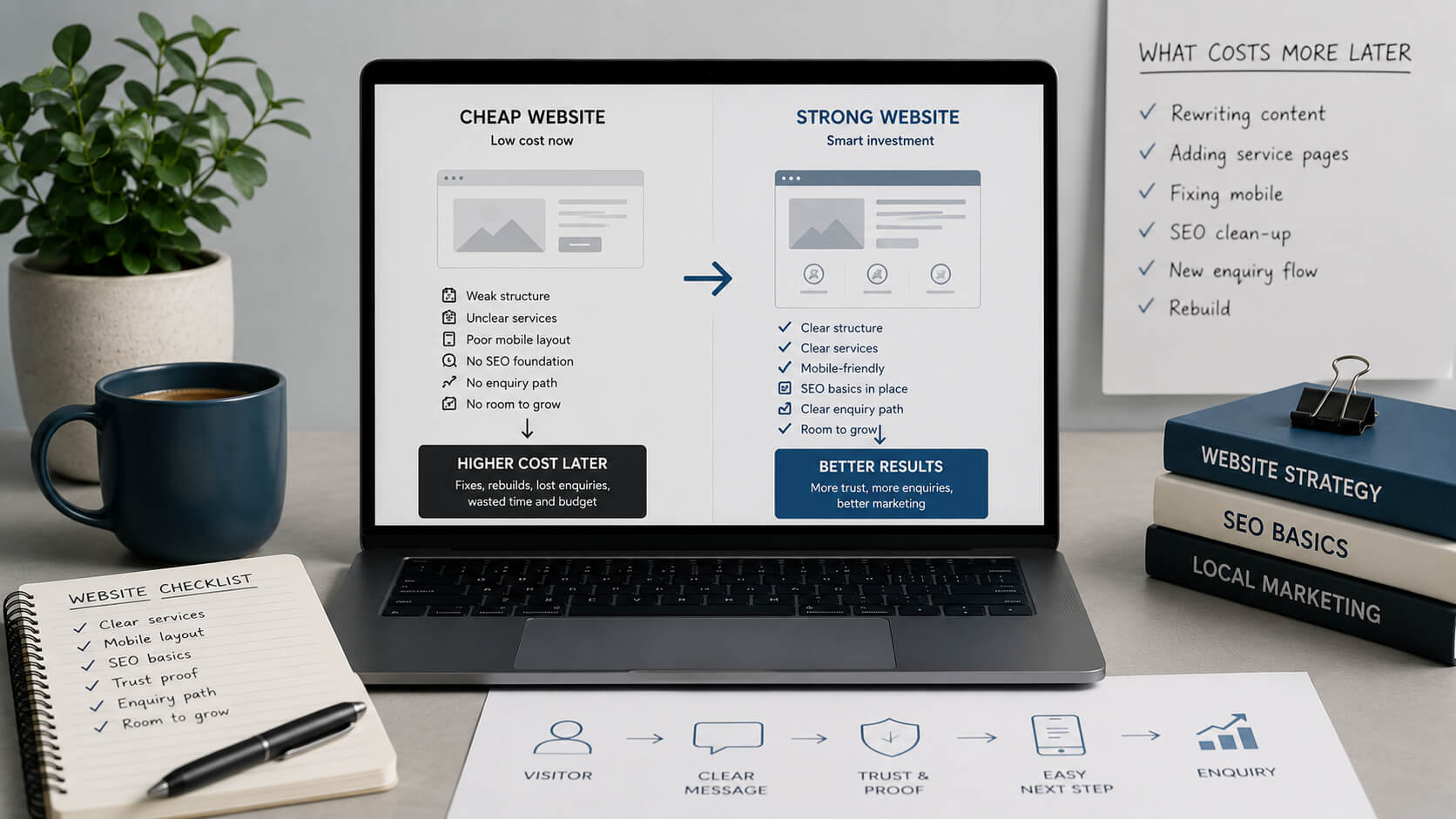
A cheap website is not always a bad website.
Sometimes a small business only needs a simple starting point. If the service is clear, the structure is planned and the basics are done properly, a small website can work well.
The problem starts when the price is low because important work has been skipped.
That kind of website can look acceptable at launch, but cost more later when the business needs enquiries, SEO, Google Ads, new pages or a proper rebuild.
Cheap becomes expensive when the site has no clear base.
Cheap design is not the same as a simple website
A simple website can still be planned properly.
It can have:
- clear service wording
- mobile-friendly layout
- contact buttons
- basic SEO setup
- FAQ section
- trust proof
- clean page structure
- secure connection
- room to add more pages later
That is a simple website.
A cheap website is different when it only gives you a few blocks, vague text and no proper structure.
It may be live, but it is not really ready to support the business.
Weak structure costs more later
Website structure is the order of the pages and sections.
It decides how visitors move through the site.
If the structure is weak, the website becomes harder to improve.
Common structure problems
A weak website may have:
- no clear homepage message
- all services squeezed into one small section
- no proper service pages
- no FAQ page
- no recent work page
- no clear contact path
- no internal links
- no room for future content
Later, when the business needs more enquiries, the site may need to be rebuilt instead of simply updated.
Useful page: Website Upgrade Ireland
Unclear services lose enquiries
A small business website must explain what the business actually does.
This sounds obvious, but many cheap websites use generic wording.
Weak wording
Professional solutions for your needs.
Clearer wording
Garden tap installation for homeowners in Meath and nearby areas.
The second version is useful.
It tells people what the service is, who it is for and where it is available.
If services are unclear, visitors hesitate. Some leave. Some contact a competitor instead.
That lost enquiry is part of the real cost.
Poor mobile layout hurts trust
Many people will first see your website on a phone.
If the mobile version is awkward, the website will lose trust quickly.
Poor mobile layout can mean:
- text is too small
- buttons are hard to tap
- images crop badly
- forms are difficult to use
- contact details are hidden
- sections are too long
- the page loads slowly
- the menu is confusing
A website can look fine on a desktop and still fail on mobile.
Fixing mobile layout later can take time, especially if the original site was not built with mobile structure in mind.
No SEO base means harder growth
SEO means helping your website appear when people search for your services.
A cheap website may skip the basics.
Missing SEO basics can include:
- weak page titles
- no proper headings
- poor page descriptions
- no image alt text
- unclear service wording
- no internal links
- no FAQ content
- poor URL structure
- no structured data
SEO is not magic added later.
The website needs a clean base from the start.
If the base is weak, later SEO work often starts with repair.
Useful page: Website Growth Support Ireland
No enquiry path means no clear next step
A business website should guide people towards action.
That action may be:
- calling
- sending a message
- filling in a form
- requesting a quote
- booking
- sending photos
A cheap website may have a contact page, but no real enquiry path.
A weak enquiry path may have:
- vague buttons
- hidden phone number
- long form
- no quote instructions
- no service-specific contact section
- no WhatsApp or call option where needed
- no explanation of what happens next
If visitors are ready to enquire but cannot see the next step, the website is wasting interest.
Missing trust proof makes the site feel thin
People need reasons to trust a business.
A cheap website often skips trust sections because they take time to plan.
Trust proof can include:
- real photos
- reviews
- case studies
- recent work
- process steps
- years in business
- service area
- guarantees where relevant
- clear business details
Without proof, the site may look generic.
It may not feel like a real active business.
For local service businesses, real proof often matters more than fancy design.
Useful page: Websites for Local Service Businesses in Ireland
No room to grow creates another rebuild
A small website should not block future growth.
Even if the first version is small, it should be possible to add:
- new service pages
- FAQs
- articles
- case studies
- location information
- Google Business Profile links
- landing pages
- enquiry sections
If the site was built as a quick one-off page with no growth plan, every future improvement becomes awkward.
That is how a cheap website can lead to a second project sooner than expected.
Cheap websites can make marketing harder
Marketing needs useful pages.
If you run Google Ads, post on Google Business Profile, share on Facebook or send people from referrals, the website must support that traffic.
A weak website makes marketing less effective.
Marketing needs pages that explain:
- the service
- the offer
- the location
- the proof
- the next step
- the common questions
- the enquiry route
If those pages do not exist, marketing sends people to a weak destination.
That can waste time and budget.
Fixing later can cost more than building properly first
A cheap website may later need:
- content rewrite
- homepage restructure
- new service pages
- mobile rebuild
- SEO setup
- contact form replacement
- FAQ section
- redirects
- trust blocks
- technical fixes
- full rebuild
At that point, the business pays twice.
First for the cheap website.
Then for the repair or rebuild.
This does not mean every small website must be expensive. It means the essentials should not be skipped.
When a low-cost website is acceptable
A lower-cost website can be a good choice when the scope is honest and simple.
It can work if:
- the business has one clear service
- the page structure is planned
- the wording is direct
- mobile layout is clean
- contact options are visible
- basic SEO is included
- supporting pages are added
- the site can grow later
That is a proper small website.
Not just a cheap one.
The simple test before choosing a cheap website
Before accepting a very low price, ask what is included.
Check:
- Will the services be clearly explained?
- Will the site work properly on mobile?
- Will there be basic SEO setup?
- Will the contact path be clear?
- Will there be FAQ or support pages?
- Will images have alt text?
- Will SSL be connected?
- Will the site be easy to expand later?
- Will the website be handed over properly?
- Will the page structure be planned before design?
If these answers are unclear, the low price may not be the real final cost.
A better way to start
The better first step is a review.
Send the current website, or describe what you need built.
Then the work can be priced around the real scope, not a guess.
Useful pages:
Build the base properly
A website does not need to be overbuilt.
It does need to be clear.
The real risk with a cheap website is not that it costs little at the start.
The risk is that it gives the business a weak base: unclear services, poor mobile layout, no SEO foundations, no enquiry path and no room to grow.
That is what costs more later.
Need a clear website review?
Send your current website or explain what you need built.
Site Launch can review the starting point and give a practical recommendation before work begins.
No guesswork. Just a clear look at what the website needs to do.