


The honest answer is simple:
a website upgrade costs what the work takes to plan, write, build, test and publish properly.
Random prices without context can be misleading. They often do not match the real work needed.
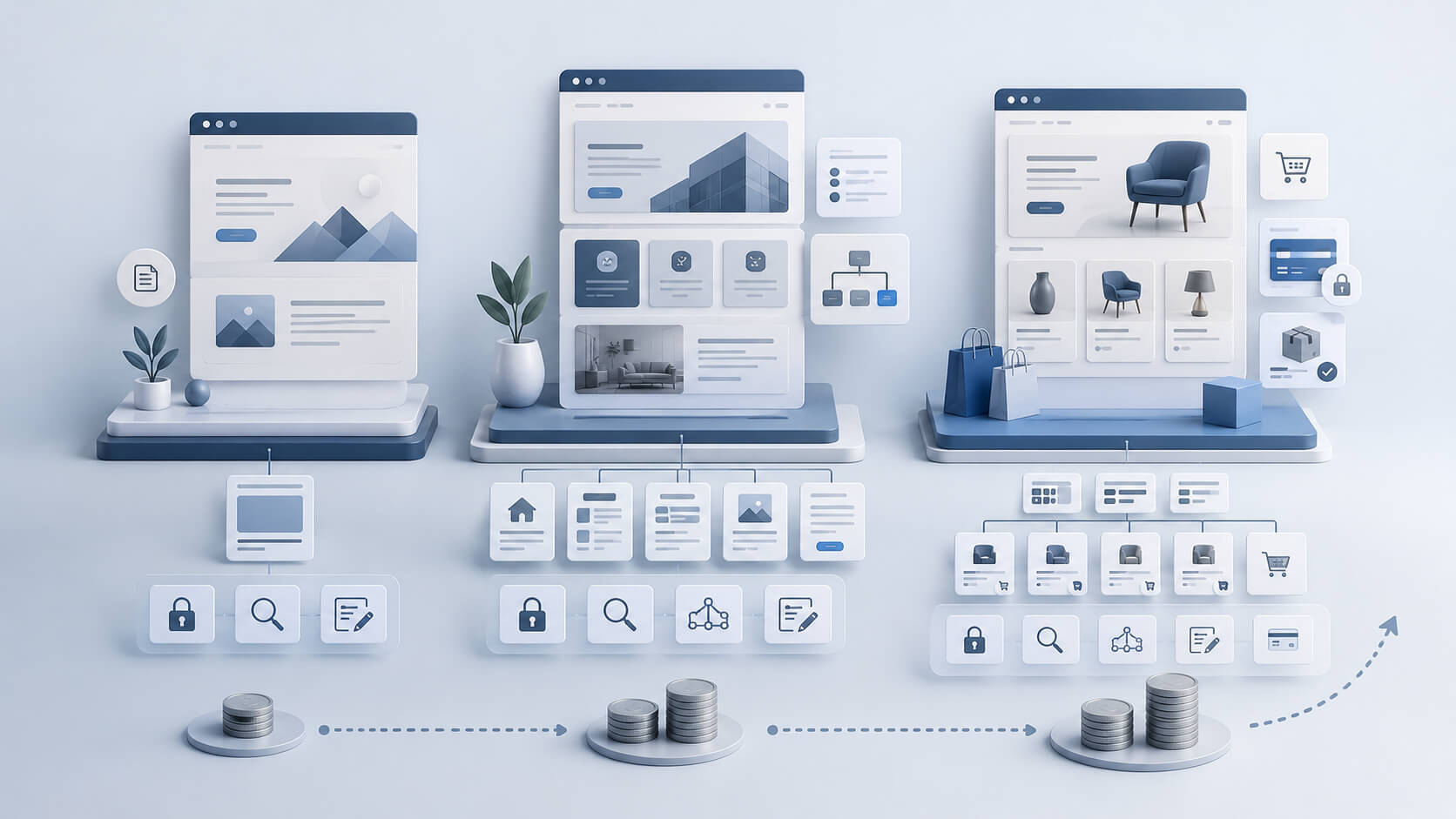
A small one-page website is not the same as a multi-page service website. A service business website is not the same as an online shop. A clean rebuild is not the same as fixing a messy old website with poor structure, weak text and missing technical basics.
Still, it is useful to have a rough idea.
Below is a practical guide for small Irish businesses.
Why website prices vary
Website cost usually depends on:
- number of pages
- amount of content needed
- number of services
- mobile layout
- enquiry setup
- contact forms
- SEO setup
- images and visual work
- technical setup
- old website clean-up
- online shop requirements
- payment system setup
- how much planning is needed
The more work the website needs, the more time it takes.
That is what affects the price.
Simple one-page website: from €400–€500
A one-page website suits a business with one clear service.
For example, a small business that only installs outdoor garden taps.
That sounds simple, but even a one-page website still needs proper planning.
It is not just one long block of text and a phone number.
What the homepage should include
A strong one-page website should usually include:
- clear hero section
- short explanation of the service
- who the service is for
- service area
- what is included
- simple process
- trust points
- recent work or photos
- FAQ section
- contact section
- call or enquiry button
- basic SEO setup
The page should quickly answer:
What do you do?
Where do you work?
Can I trust you?
How do I contact you?
Why a one-page website still needs supporting pages
Even if the main website is one page, it still needs a few supporting pages.
These pages are not decoration. They help the site work properly.
Useful supporting pages
Terms page
Explains basic conditions, responsibilities and service information.
Privacy policy page
Needed if the site collects contact details through forms, email links or tracking tools.
FAQ page
Answers common questions before people call or message.
Contact page
Gives a clear place for phone, email, enquiry form and business details.
Recent works page
Shows real work and gives visitors proof that the business is active.
404 error page
This is the page visitors see if a link is broken or a page no longer exists. A clean 404 page helps guide them back instead of leaving them stuck.
A “simple” website still needs these basics if it is going to feel professional and usable.
What technical setup is included
A website also needs basic technical work. This is not glamorous, but it matters.
Microdata / structured data
Microdata, or structured data, is extra information added to the website code.
It helps Google understand the page better.
For example, it can tell Google:
- this is a local business
- this is a service page
- this is an FAQ section
- this is the business name
- this is the service area
- this is the contact information
It does not guarantee top rankings.
But it gives Google clearer information than a plain page without structure.
That can give your website a cleaner base than competitors who only publish text and images without proper markup.
Basic SEO setup
SEO means helping your website appear when people search for your service.
For a simple website, basic SEO setup can include:
- clear page title
- short page description
- correct headings
- simple URL structure
- image alt text
- internal links
- readable service wording
- FAQ content
- mobile-friendly layout
SEO is not just adding keywords.
It is making the website understandable for customers and search engines.
SSL certificate
SSL is what gives the website a secure connection.
It is the reason a website shows https instead of just http.
It helps protect data sent through the site, such as form enquiries.
It also makes the site look more trustworthy. A website without SSL can show a browser warning, which is bad for trust.
Timeline and price
A simple one-page website usually takes:
6–14 days
Typical price:
€400–€500
This depends on how much content, structure, image work and setup are needed.
Multi-page website: from €600
A multi-page website is better for a business that offers more than one service.
Instead of trying to explain everything on one page, each important service gets its own space.
This makes the website clearer for customers and easier for Google to understand.
Example: florist website
A florist may not need only one general page.
The business may offer:
- wedding flowers
- funeral flowers
- birthday bouquets
- corporate flowers
- seasonal flowers
- local delivery
- flower subscriptions
- gift arrangements
Each of these services has different customers, questions and search intent.
Someone looking for wedding flowers is not the same as someone ordering a birthday bouquet.
A multi-page structure helps separate those needs.
What a multi-page website may include
A multi-page website can include:
- homepage
- main service pages
- about page
- FAQ page
- contact page
- delivery or service area page
- recent work or gallery
- enquiry or quote page
- blog or advice section
This gives the business more room to explain services properly.
It also gives future SEO and content work a stronger base.
Useful page: Websites for Local Service Businesses in Ireland
Timeline and price
A multi-page website usually takes:
10–20 days
Typical price:
from €600
The final price depends on the number of pages, content volume, photos, structure and technical work needed.
E-commerce website: from €1,200
An e-commerce website is for a business that sells products online.
This is more complex than a normal service website.
You are not only presenting the business. You are also handling products, payments, delivery and customer decisions.
What an e-commerce website needs
An online shop may need:
- product catalogue
- product categories
- individual product pages
- product images
- product descriptions
- SEO setup for each product
- payment system
- delivery information
- returns information
- terms and privacy pages
- checkout setup
- order confirmation flow
- mobile shop layout
Each product should be treated properly.
A weak product page can hurt sales.
A strong product page should explain what the item is, who it is for, what makes it useful and how delivery works.
Timeline and price
An e-commerce website usually takes:
from 15 days
Typical price:
from €1,200
The final price depends on the number of products, catalogue structure, payment setup, delivery rules and amount of content needed.
Why fixed prices can be misleading
A price is only useful when the scope is clear.
For example:
A one-page site with supplied text and photos is not the same as a one-page site where the content, structure, images, SEO and enquiry flow all need to be built from scratch.
A multi-page website with three services is not the same as one with fifteen services.
An online shop with ten products is not the same as one with one hundred products.
That is why the best first step is not guessing.
The best first step is a review.
How the work process works
Site Launch works through a clear process.
1. Website audit
We review the current website if you have one.
If you do not have a website yet, we review the business, services, audience and starting point.
2. Proposal and roadmap
You get a clear proposal showing what should be built or upgraded.
This includes the likely structure, key pages and next steps.
3. Website structure
The pages and sections are planned before design starts.
This prevents random blocks and unclear service pages.
4. Texts and photos
The website needs clear wording and suitable visuals.
If photos are missing, we define what is needed or prepare suitable visual direction.
5. Prototype
The page structure is laid out before final build.
This helps check flow, logic and content order.
6. Build
The website is built with mobile layout, service pages, contact routes and technical setup.
7. Technical setup
This includes basic SEO, SSL, structured data, forms, redirects where needed and launch checks.
8. Publication
The website is published and checked.
9. Handover
The website is passed into your hands, with the core structure ready to use and grow.
What happens after publication
A website should not be left untouched after launch.
After publication, the site can keep improving with:
- new service pages
- FAQ updates
- articles
- case studies
- Google Business Profile posts
- better enquiry paths
- content updates
- SEO improvements
This is where ongoing support helps.
Useful page: Website Growth Support Ireland
A new or upgraded website gives the business a better base.
Growth comes from continuing to improve that base over time.
Which option fits your business?
A simple one-page website may suit you if:
- you offer one clear service
- the business is straightforward
- you need a professional starting point
- the site does not need many separate pages yet
A multi-page website may suit you if:
- you offer several services
- customers need different information
- you need stronger SEO structure
- you want room for articles, FAQs and future growth
An e-commerce website may suit you if:
- you sell products online
- you need product pages
- you need payment setup
- you need catalogue and delivery structure
Get a clear price before starting
The best way to get the right price is to send the current website or explain what you need built.
You do not need a perfect brief.
A short message is enough.
Site Launch can review the current situation and give a practical proposal, roadmap and final price.
Useful starting points:
Need a website upgrade price?
Send your current website, or describe what you need built.
You will get a clear recommendation, a practical roadmap and a final price before work starts.
No inflated pitch. Just a clear look at what the website needs to do. Get your FREE Review