

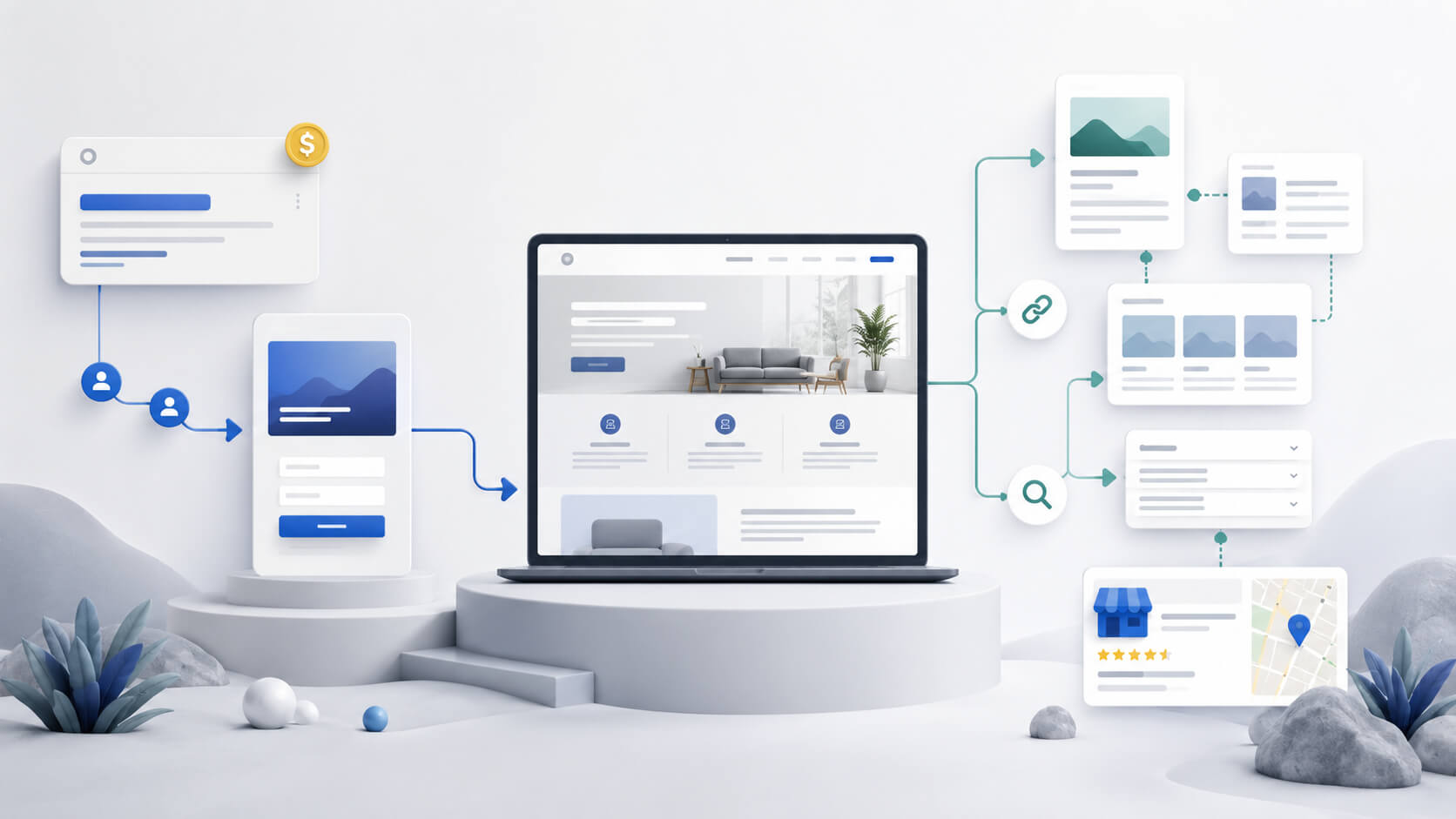
Google Ads and organic growth can both help a small business get more enquiries.
But they work differently.
Google Ads can bring visitors faster because you pay for clicks.
Organic growth is slower because it depends on useful pages, service content, search visibility and steady improvement.
The important point is this:
both need a clear website before they can work properly.
A weak website can waste ad budget.
A weak website can also slow down organic growth.
Google Ads are faster
Google Ads can put your business in front of people who are already searching.
That is useful when you need enquiries sooner.
For example:
- a new service has launched
- you need leads quickly
- organic traffic is still low
- you want to test demand
- you want to promote a focused offer
- you need traffic to a specific landing page
Ads can work quickly because the traffic is paid.
But speed has a cost.
You pay for every click.
If the page is weak, unclear or hard to contact from, those clicks can be wasted.
Organic growth is slower
Organic growth means improving the website so it can be found naturally over time.
This usually comes from:
- clear service pages
- useful articles
- FAQs
- case studies
- internal links
- Google Business Profile support
- better page structure
- ongoing website updates
Organic growth takes longer because Google needs time to understand the site.
Customers also need useful pages that answer real questions.
The advantage is that organic visibility can become cheaper over time than paying for every visitor.
Useful page: Website Growth Support Ireland
Ads are faster, but you pay for every click
This is the simple difference.
Ads are faster, but you pay for every click.
That means the page receiving the traffic must be ready.
A Google Ad can bring someone to the website.
It cannot make the page clear.
It cannot add trust proof.
It cannot fix a bad mobile layout.
It cannot make a long form easier to use.
That work has to be done before the budget is spent.
Organic growth is slower, but cheaper over time
Organic website growth is not instant.
It takes planning and steady content work.
But it can build a stronger long-term base.
A small business website can grow through:
- better service pages
- articles answering customer questions
- FAQ improvements
- recent work pages
- local service information
- case studies
- Google Business Profile posts
This helps the website become more complete and useful.
Over time, that can reduce dependence on paid traffic.
The website comes before both
The wrong question is:
Should I do Google Ads or organic growth?
The better question is:
Is the website ready for either?
Before spending on ads or planning SEO growth, the website should have:
- clear service pages
- strong mobile layout
- trust proof
- fast enquiry path
- useful FAQs
- simple page structure
- clear contact options
- basic SEO setup
If these are missing, both ads and organic growth become harder.
Useful page: New Website Build Ireland
When Google Ads should come first
Google Ads can make sense first when the business needs faster traffic.
Ads may be useful when:
- the website already has a clear landing page
- the offer is easy to understand
- the enquiry path is ready
- the mobile version works well
- trust proof is visible
- the business needs leads quickly
- there is budget to test and adjust
In this case, ads can bring useful traffic while organic growth is still developing.
But the page must be ready before the clicks start.
When organic growth should come first
Organic growth should usually come first when the website is weak or incomplete.
Organic work may be the better first step when:
- service pages are thin
- the homepage is unclear
- FAQs are missing
- there are no case studies
- Google Business Profile has nowhere useful to link
- the mobile layout is poor
- the site has no content base
- the business cannot yet explain its offer clearly
In this situation, spending on ads too early may only expose the website problems faster.
Useful page: Website Upgrade Ireland
A strong landing page helps ads
A Google Ads landing page should match the service being advertised.
If someone clicks an ad for a website upgrade, the page should be about website upgrades.
Not a general homepage with several unrelated messages.
A strong landing page needs:
- clear headline
- service match
- short explanation
- trust proof
- visible CTA
- mobile-friendly layout
- simple contact path
- tracking basics
This helps paid traffic move towards enquiry.
Strong service pages help organic growth
Organic growth needs clear pages that explain what the business offers.
A general website with vague text gives Google and customers less to work with.
Good service pages explain:
- what the service is
- who it is for
- what problem it solves
- where it is available
- what is included
- why people can trust the business
- how to enquire
These pages also support articles, FAQs and Google Business Profile posts.
Useful page: Websites for Local Service Businesses in Ireland
Google Business Profile supports both
Google Business Profile can support organic visibility and paid marketing.
But it needs useful website pages behind it.
A post about a service should link to a relevant service page.
A post answering a common question should link to an FAQ or article.
A post showing recent work should link to a case study or related service page.
If every post only links to a weak homepage, the marketing path is limited.
The best approach is often both, but not at the same stage
Many small businesses need both paid and organic work.
But not always at the same time.
A sensible order can be:
- Fix the website structure
- Build clear service pages
- Improve the enquiry path
- Add trust proof
- Start useful content growth
- Use Google Ads when the landing page is ready
- Keep improving the website over time
This avoids sending paid traffic to a weak site.
It also gives organic growth a stronger base.
Do not use ads to hide a weak website
Google Ads should not be used to compensate for unclear website structure.
If the website does not explain the service, ads will not solve that.
If the mobile page is poor, ads will not solve that.
If there is no trust proof, ads will not solve that.
Ads bring visitors.
The website has to convert them.
Simple test before choosing ads or organic growth
Before deciding, check the website.
Ask:
- Is the main service clear?
- Is there a focused landing page?
- Does the mobile version work well?
- Is there proof people can trust?
- Is the contact path fast?
- Are service pages strong enough?
- Are FAQs and articles supporting the site?
- Can Google Business Profile posts link to useful pages?
If the answer is no, improve the website first.
Which should come first?
If the website is clear and ready for enquiries, Google Ads can be a useful fast traffic option.
If the website is weak, organic growth and website improvement should usually come first.
The practical answer is:
build the base first, then choose the traffic.
A strong website makes ads safer.
It also makes organic growth more realistic.
Need a website ready for marketing?
Site Launch builds and upgrades websites for small Irish businesses that need clear service pages, stronger enquiry paths and a better base for Google Ads, SEO and content growth.