


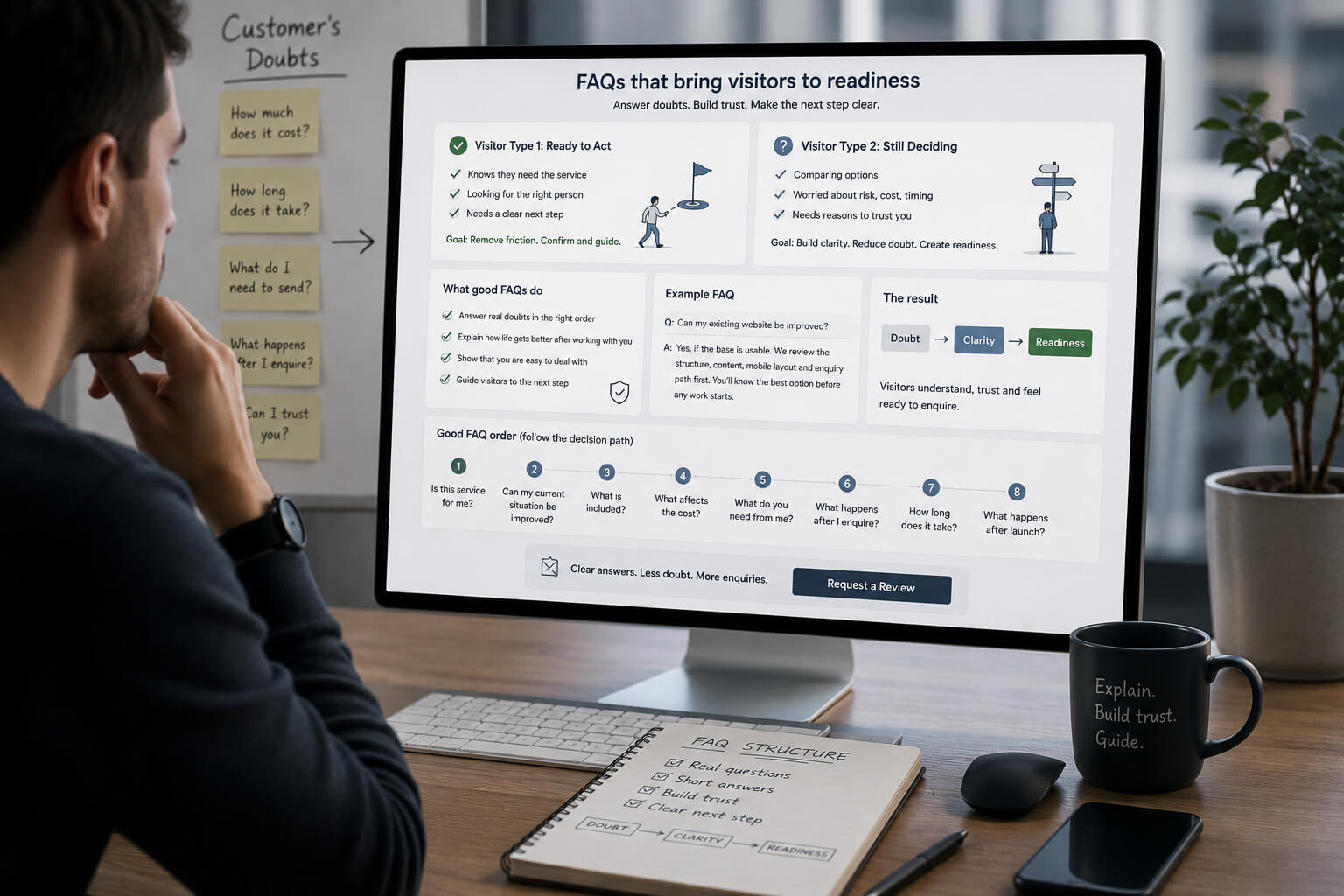
A website has two types of visitors.
The first already knows they need your service.
They have decided. They are looking for the right person or business.
The second is not ready yet.
They are comparing options, checking risks, thinking about cost, looking for reasons not to make a mistake.
A good website should serve both.
A good FAQ section is one of the simplest ways to do it.
Ready visitors need a clear path
Some visitors arrive already prepared to act.
They do not need a long explanation.
They need confirmation.
They are checking:
- do you offer the service?
- do you work in my area?
- can I trust you?
- how do I contact you?
- what happens next?
For these people, FAQs should remove practical friction.
Short answers work best.
Example
What should I send first?
Send your current website link and a short note about what feels unclear. I will review it and suggest the clearest starting point.
This does not sell hard.
It shows the next step.
Undecided visitors need orientation
The second type of visitor is harder.
They are not ready to buy.
They may not even know what they need yet.
They are thinking:
- is this worth doing now?
- can my current website be fixed?
- will this cost more than I expect?
- will I be pushed into something I do not need?
- can I deal with this person?
This is where FAQ content matters.
It helps the reader become internally ready.
Not forced.
Ready.
Good FAQs do what good salespeople do
Experienced salespeople can move a person from uncertainty to decision.
Not by shouting.
By understanding the doubt before the customer fully says it.
That skill is rare.
Thankfully.
If every salesperson had it, we would all be buried under things we never needed.
A website cannot fully replace that kind of person.
But it can do part of the same work.
It can answer doubts in the right order.
It can make the service feel understandable.
It can show that dealing with you will probably be straightforward.
FAQs should not “sell”
A bad FAQ tries to close the deal.
A good FAQ explains.
There is a difference.
Weak answer
Yes, we are the best choice for your website upgrade.
Better answer
If the existing website has a usable base, it can often be upgraded instead of rebuilt. The first step is to review the structure, mobile layout, service pages and enquiry path.
The better answer gives the reader useful judgement.
It does not ask them to believe a claim.
Show how life gets better after working with you
This does not need to be dramatic.
For most small businesses, the improvement is practical.
After working with you, the customer should have less confusion, less risk, less wasted time or a clearer next step.
Example
Before:
The business owner keeps explaining the same basic information on calls.
After:
The website explains the service, answers common questions and shows people what to send before enquiring.
That is a real improvement.
The FAQ should help the reader see that future state.
Give the signal: you can be dealt with
A visitor is not only judging the service.
They are judging the business behind it.
They want to know if dealing with you will be awkward, vague or clean.
FAQs can signal this clearly.
Good FAQ answers show:
- you understand common doubts
- you explain things plainly
- you do not hide basic information
- you do not overpromise
- you have a process
- you know what happens next
This is often more persuasive than a big claim about quality.
Put doubts in the right order
The FAQ order should follow the visitor’s thinking.
Do not place questions randomly.
Better order
- Is this service for me?
- Can my current situation be improved?
- What is included?
- What affects the cost?
- What do you need from me?
- What happens after I enquire?
- How long does it take?
- What happens after launch?
This order moves from uncertainty to action.
That is the point.
Keep each answer short
One question should get one answer.
Not a speech.
Weak answer
The cost of a website upgrade can depend on many different elements and varies between businesses because each company has different needs and goals, so it is important to review everything first before making any decision.
Better answer
The cost depends on scope: pages, content, mobile layout, enquiry setup and technical work. A review gives a clearer price before work starts.
Shorter. Clearer. More useful.
Do not repeat the main page
FAQs should not duplicate the same content already on the page.
They should answer what the main page has not fully resolved.
Main page
We improve unclear websites with better structure, wording, mobile layout and enquiry paths.
FAQ
Can you improve an existing website instead of rebuilding it?
Yes, if the base is usable. If the structure is too weak, a rebuild may be the cleaner option.
That adds judgement.
It does not repeat the same line.
Useful page: Website Upgrade Ireland
Use FAQs as soft conversion points
Not every FAQ needs a button.
But some answers should naturally lead to the next step.
Example
What happens after I send my website?
I review the current setup and send a practical recommendation. You will know whether the website needs a small upgrade, a rebuild or ongoing growth support.
Useful next page: Website Growth Support Ireland
The answer gives direction without pressure.
FAQs also help SEO
FAQs add useful search language to the page.
They include the words people actually use when they are unsure.
That helps search engines understand the page.
But the wording should stay natural.
Bad
Do you offer website upgrade Ireland website upgrade services for website upgrade Ireland clients?
Better
Do you upgrade existing websites for small Irish businesses?
Clear for people.
Useful for search.
A good FAQ section changes the reader’s state
The best FAQ section does not just provide information.
It changes the reader’s state.
Before reading, they may feel unsure.
After reading, they should feel:
- I understand what this service does
- I know whether it fits me
- I know what happens next
- I am not being pushed
- this business seems clear and safe to deal with
That is the real job.
FAQ checklist
Before publishing an FAQ section, check:
- does it answer real doubts?
- does it help both ready and undecided visitors?
- does it explain without pressure?
- does it show how the situation improves?
- does it signal that you are easy to deal with?
- does each answer stay short?
- does the order follow the customer’s decision path?
- does it support the enquiry path?
If the answer is no, the FAQ is only content.
It is not doing structural work.
FAQs are quiet sales structure
A website should not trap people into buying.
It should help them understand whether they should act.
Good FAQs do that quietly.
They reduce uncertainty.
They explain the outcome.
They show the process.
They make the next step feel safe.
That is how a website brings a visitor closer to readiness without sounding like a hard sell.
Need stronger FAQ structure?
Site Launch builds and improves small business websites with clear service pages, useful FAQs and simple enquiry paths.