


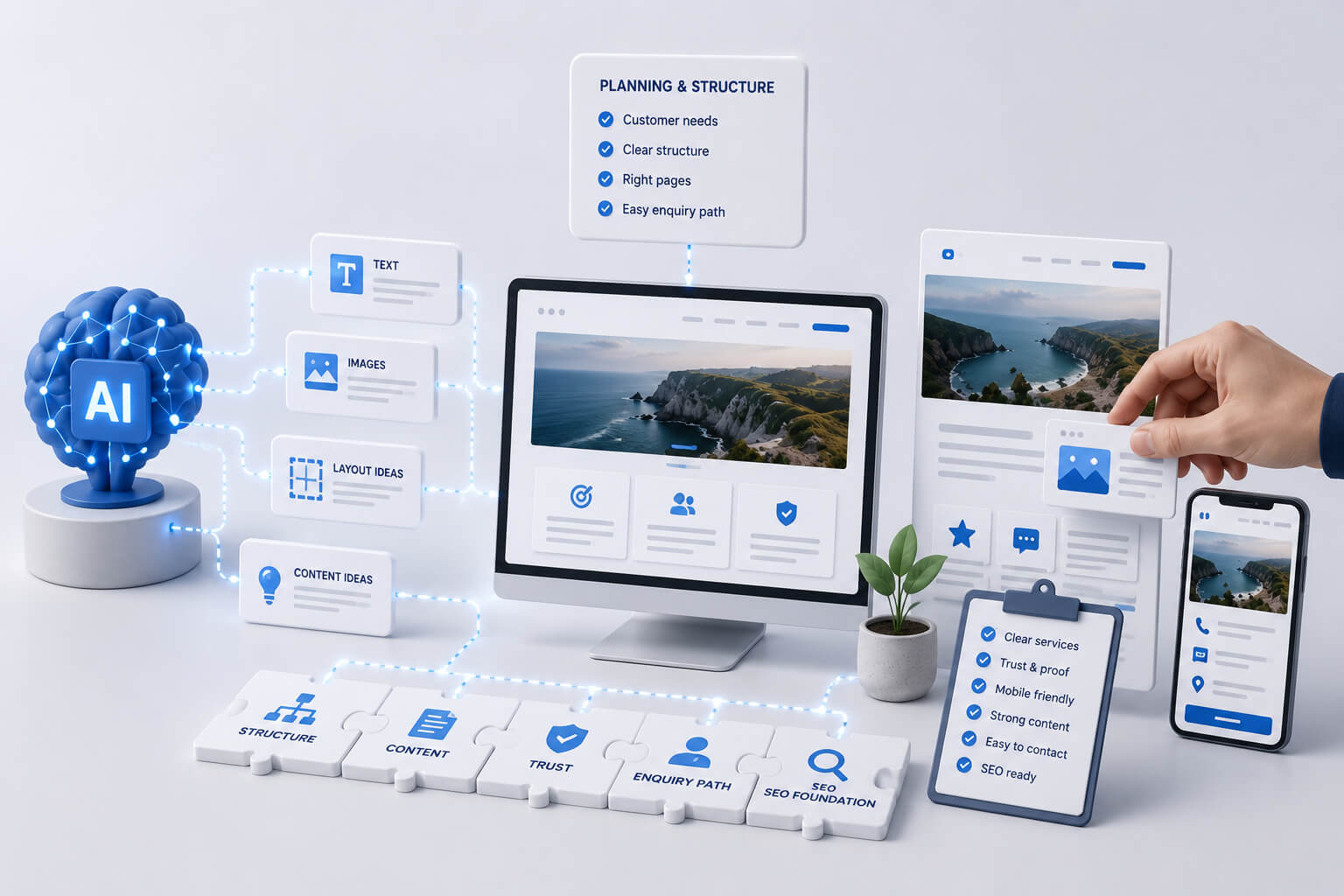
AI can help you write text, suggest sections, create image ideas and speed up parts of website work.
But it does not remove the need to understand websites.
This is where many small business owners get caught.
AI can produce something that looks finished. It can write polished text, suggest a layout and generate a list of pages.
But a useful business website is not just text and design.
It needs structure, customer understanding, trust, clear services and a simple path to enquiry.
Without that knowledge, AI can make the wrong website faster.
AI is useful, but it needs direction
AI works well when the person using it knows what they are trying to build.
It can help with:
- headline ideas
- first drafts
- FAQ drafts
- article outlines
- image prompts
- rewriting unclear text
- simple page planning
But AI needs proper input.
If the brief is weak, the result will usually be weak.
For example, if you ask AI to “make a website for my business”, it may create a generic structure.
That does not mean the structure is right for your customers.
A website needs decisions, not just output
AI can suggest options.
Someone still has to decide what is correct.
A business website needs decisions about:
- which pages are needed
- what should appear on the homepage
- which services need separate pages
- what customers need to know before enquiring
- where reviews or proof should appear
- what contact route is best
- what content should be removed
That judgement matters.
A website with too many sections can become confusing.
A website with too little detail can fail to build trust.
AI will not automatically know the right balance.
Good websites are built around customer questions
A small business website should answer the questions real customers ask.
These are often simple:
- What do you do?
- Do you work in my area?
- How much does it cost?
- What happens after I enquire?
- Can I trust you?
- Do I need to send photos?
- How long does it take?
- How do I contact you?
AI can guess these questions, but it does not know your real enquiries unless you give it that information.
That is why business knowledge is still needed.
The website should be based on how customers actually think, not just on what AI thinks a website should include.
AI often makes weak content sound better
One of the biggest risks is polished but empty wording.
AI can easily produce text like:
- tailored solutions
- professional service
- customer-focused approach
- high-quality results
- helping your business grow
This sounds fine, but it says very little.
A customer needs clearer information:
- what service you provide
- who it is for
- where you work
- what is included
- why they should trust you
- how to enquire
A good website is not about sounding impressive.
It is about being easy to understand.
Website structure still matters
Structure is the order of the website and how pages connect.
For a small business, this might include:
- homepage
- service pages
- FAQ page
- contact page
- case studies
- articles
- service area information
AI may suggest pages, but it may not know which pages matter most.
For example, a business with several services may need separate service pages, not one general “Services” page.
That structure helps visitors.
It also helps Google understand the website.
Useful page: Websites for Local Service Businesses in Ireland
AI does not replace SEO basics
SEO means helping your website appear when people search for your services.
AI can write text with keywords, but SEO is not only keywords.
A website also needs:
- clear page titles
- useful headings
- proper service pages
- internal links
- readable mobile layout
- clear page descriptions
- useful FAQs
AI can help create these parts.
But someone still needs to know what should be built and why.
Useful page: Website Growth Support Ireland
AI cannot create real proof
A website needs trust.
AI cannot invent real proof.
Trust comes from:
- project photos
- reviews
- case studies
- real examples
- clear contact details
- honest service information
- a simple process
For local service businesses, real proof is often stronger than perfect writing.
A website made only from AI text can feel generic if it has no real business detail behind it.
The problem is not AI. The problem is using it without a plan.
AI is a useful tool.
It can save time.
It can help organise ideas.
It can make drafting easier.
But it cannot replace the thinking behind a good website.
Before using AI, the business still needs a clear plan:
- what the website must achieve
- who the customer is
- what services need to be explained
- what trust signals are available
- how enquiries should happen
- what pages are needed now
- what can be added later
Without that, AI can produce a site that looks active but does not support the business properly.
Simple test for an AI-made website
If you use AI to help build a website, check the result like a customer.
Can the visitor quickly understand:
- what the business does?
- where it works?
- which service is right for them?
- why they should trust it?
- how to enquire?
- what happens next?
If not, the website needs better planning.
Not more AI text.
AI should support website work, not replace it
AI can help with website work when it is used properly.
But a strong business website still needs structure, judgement, customer understanding and real proof.
AI can generate parts.
Website knowledge decides what those parts should be and how they should fit together.
For most small businesses, that difference matters.
A website should not just look complete.
It should help people understand the business and make contact.
Need a website planned properly before it is built?
Site Launch builds websites for small Irish businesses with clear structure, practical content, enquiry paths and room for future growth.
Useful pages: