

Site Launch builds websites that are ready to support Google Ads and paid traffic.
That does not mean Google Ads are included in every website project.
It means the website is planned so that, when you do decide to advertise, the site is not the weak part of the marketing.
A Google Ad can bring people to your website.
The website still has to do the work.
It must explain the service, build trust, work well on mobile and make it easy for the visitor to enquire.
If the website is unclear, paid traffic can become expensive very quickly.
Google Ads brings traffic. The website must convert it.
Google Ads can place your business in front of people who are already searching.
That is useful.
But after the click, the ad has done its job.
The page must then answer the visitor’s questions:
- Am I in the right place?
- Does this business offer what I need?
- Can I trust them?
- What should I do next?
- Is it easy to contact them?
If the page does not answer these questions quickly, the visitor leaves.
That means the click was paid for, but no enquiry came from it.
What a Google Ads-ready website means
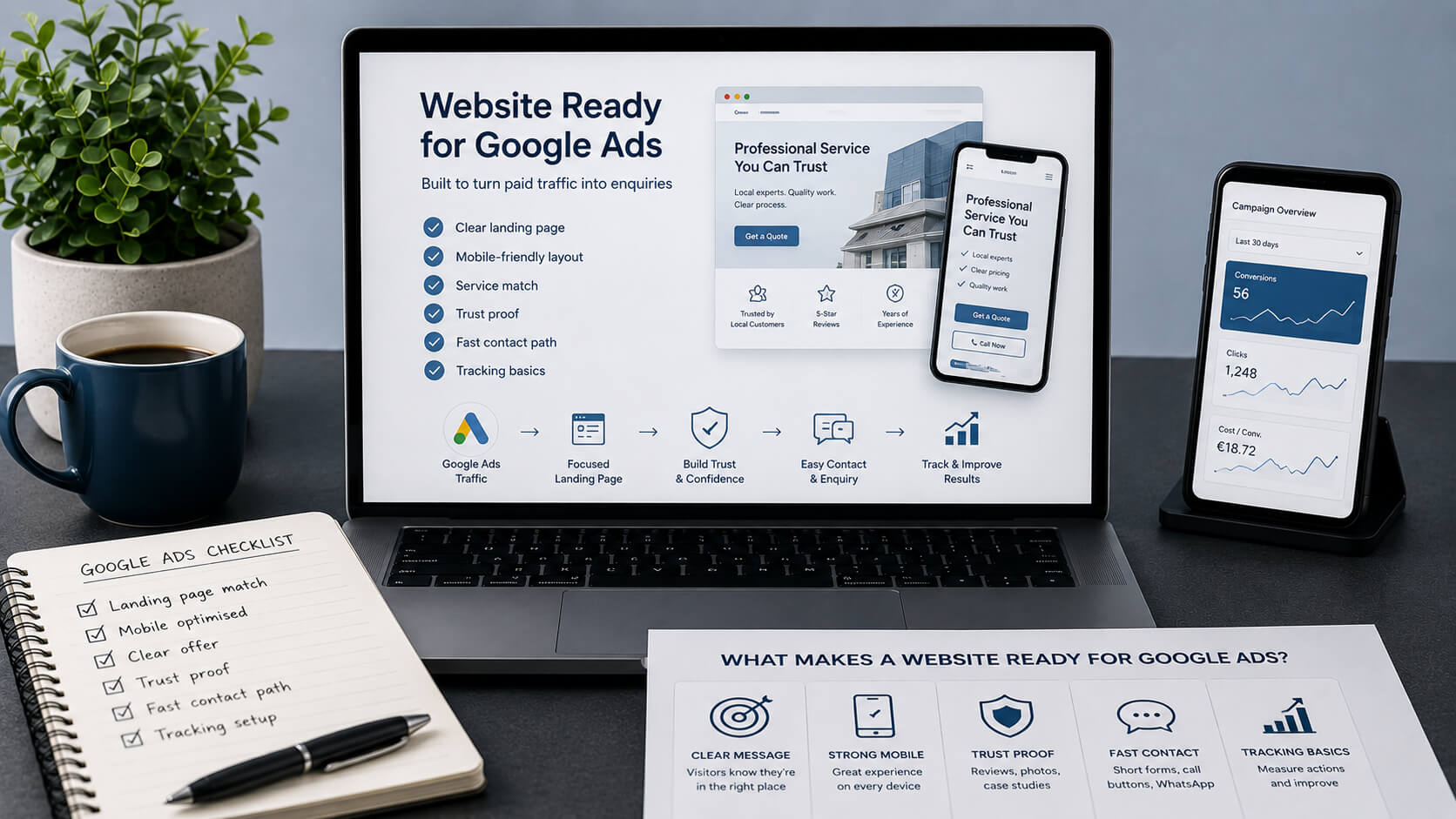
A website ready for Google Ads has the right base before the campaign starts.
It should have:
- clear landing pages
- strong mobile layout
- service match between ad and page
- trust proof
- fast contact path
- simple page structure
- basic tracking setup
- clear calls to action
It does not need to be complicated.
It needs to be clear.
Useful page: New Website Build Ireland
The landing page must match the ad
A landing page is the page someone lands on after clicking an ad.
For Google Ads, this page should closely match the search and the ad.
Example
If someone clicks an ad for website upgrades, they should land on a page about website upgrades.
Not a general homepage that makes them search for the right section.
If someone searches for Google Ads-ready website support, the page should explain:
- what the service includes
- who it is for
- why the website needs to be prepared first
- what the next step is
A clear match reduces confusion.
Confusion wastes paid clicks.
The first screen matters
The first screen is what a visitor sees before scrolling.
It should make the offer clear straight away.
A strong first screen should show:
- service name
- who it is for
- main benefit
- trust signal
- clear button or contact option
Weak first screen:
Welcome to our website.
Stronger first screen:
Google Ads-ready websites for small Irish businesses.
The visitor should know within seconds whether the page is relevant.
The page should remove the main doubts
Paid visitors should not need to contact the business just to understand the basic offer.
The page should explain what the service includes, who it is for, where it is available and what happens after the enquiry.
Price or quote guidance should also be included where possible.
The page should explain what the service includes, who it is for, where it is available and what happens after the enquiry.
Price or quote guidance should also be included where possible.
Mobile layout is critical
Many paid clicks come from phones.
If the mobile page is awkward, the campaign will struggle.
A Google Ads-ready mobile page should have:
- readable text
- clean spacing
- visible contact buttons
- fast loading
- simple navigation
- short sections
- easy forms
- no clutter
A page can look good on desktop and still fail on mobile.
Before spending on ads, the mobile version must be checked properly.
Trust proof must be visible
Paid traffic mostly brings new visitors who do not know the business.
They need proof before they enquire.
Useful trust proof includes:
- reviews
- recent work
- case studies
- real photos
- clear process
- service area
- business details
- FAQs
- warranties where relevant
Trust proof should not be hidden at the bottom of the page.
It should appear before the visitor is asked to act.
Useful page: Websites for Local Service Businesses in Ireland
The contact path must be fast
Paid traffic should not be sent to a page with a weak contact route.
If people are ready to act, the next step should be obvious.
Good contact options include:
- call button
- short enquiry form
- WhatsApp link
- quote request section
- booking instruction
- contact button near the top
- repeated CTA further down the page
The contact path should match the business.
A contractor may need photos.
A service business may need a short form.
A booking-based business may need clear booking instructions.
Clear service pages support better ads
Google Ads works better when the website has clear service pages.
A general page is often too broad.
Better structure
Instead of sending all traffic to one homepage, use focused pages:
- website upgrade page
- new website build page
- growth support page
- local service business website page
- specific landing page for a campaign
Each page should have one main job.
That makes the ad and landing page easier to align.
Useful page: Website Upgrade Ireland
Tracking basics matter
Tracking means checking what happens after someone clicks.
Without tracking, it is harder to know whether ads are working.
Basic tracking can help measure:
- form submissions
- button clicks
- phone clicks
- key page visits
- enquiry actions
- campaign landing page performance
Tracking does not fix a weak website.
But it helps show what is happening.
If people click but do not enquire, the page may need improvement.
Google Ads can expose website problems quickly
Paid traffic makes website weaknesses more visible.
You may see:
- clicks but no enquiries
- visitors leaving quickly
- weak form submissions
- few phone calls
- high spend with little return
That does not always mean Google Ads is the problem.
It may mean the website was not ready for paid traffic.
Ads are faster. Organic growth is slower.
Google Ads can bring traffic faster because you pay for clicks.
Organic growth through SEO, useful pages and content usually takes longer.
Both can work.
But both need a clear website.
Ads are faster, but you pay for every click.
Organic growth is slower, but it can reduce dependence on paid clicks over time. A strong website gives both paid and organic traffic a better chance of producing enquiries.
A strong website gives both channels a better base.
Useful page: Website Growth Support Ireland
Need a website ready for Google Ads?
Site Launch builds and upgrades websites for small Irish businesses that need clear landing pages, stronger enquiry paths and a better base for marketing. Contact form WhatsApp me